
4.3.1The Case of the Heavy-Footed Teacher
Fast Times: Parts One & Two
You will be working on the following problem over the next few days. Evidence will be presented by the prosecution that your team will need to verify or refute. Be careful with your analysis; the judge is less than patient with inaccuracies in arguments!
FAST TIMES
The Case of the Heavy-Footed Teacher
Your calculus teacher is in major trouble with the police department from a remote county. The police have issued tickets with very large fines for traveling at excessive speeds during a return trip from the mountains. In addition, if the tickets are upheld, your teacher’s license will be suspended and insurance canceled! (Driving is one of the ways your teacher releases stress from teaching and without this release, upcoming tests are sure to become unbearably difficult.) The prosecution has gathered extensive data to support their case. Your task is to defend your teacher against these accusations.
FAST TIMES Cast of Characters:
Judge Ironhand: Traffic court judge for
Jerry Verigreen: The assistant District Attorney who is prosecuting the case. Trying to impress upon his boss that he can be tough on crime. This is his first case.
Officer Tightman: The officer that issued the two tickets. Known to reach the monthly ticket quota during the first week of every month.
Patrol Officer Rongway: Highway Patrol pilot who is in charge of identifying speeders between the towns of Accelerton and Geprime.
Inspector Knoclew: In charge of analyzing traffic data for the police department.
The Defendant: Your teacher. Known for high speeds and hard tests. In desperate need of your help
Council for the Defense: That’s you!
FAST TIMES, Part One—The Prosecution Presents Their Case
Prosecution: “Judge Ironhand, through extensive data collection we have solid evidence that the defendant was using excessive speeds while traveling through our tranquil law-abiding community. Through the outstanding work of our police department, we will be able to bring justice to the defendant who clearly has no respect for our laws.
As my first witness I would like to call the officer who issued the traffic citations.
Officer Tightman, what evidence do you have that first suggested the defendant was using excessive speed?”

Officer Tightman: “The defendant claims to have departed Accelerton at 3:20 p.m. A receipt from the service station in Geprime shows that the defendant arrived at 5:38 p.m.
Even with our liberal laws allowing speeds of
Judge Ironhand: “Council for the defense, how do you respond?”
Your Task: Respond to the Judge. Is Officer Tightman correct in his claim? Justify your answer. Does this prove your teacher’s guilt or innocence?
.png)
FAST TIMES, Part Two - Compelling Evidence
Prosecution: “Although I will acknowledge the mathematical prowess of my esteemed colleague, we have further evidence to suggest the defendant was traveling at an excessive speed on multiple occasions.
Using the information from our roadside cameras, we have found the following function for the distance (in miles) traveled by the defendant between Accelerton and D’exdete. I would like to now present Exhibit B, shown below, to demonstrate the first infraction.”
.png)
.png)
Your Task: Confirm or refute the prosecution’s claim by determining the maximum velocity in the interval.

Examine the following integrals. Consider the multiple tools available for evaluating integrals and use the best strategy for each part. Evaluate the definite integrals and state the strategies that you used. For the indefinite integrals, find the antiderivative function, if you can. Homework Help ✎
The three graphs below each tell a story. Examine each graph carefully and then complete each part below. Pay close attention to the labeling of the
The graph of
involves a bicycle. Use a complete sentence to describe the physical meaning of . Include units of measure.
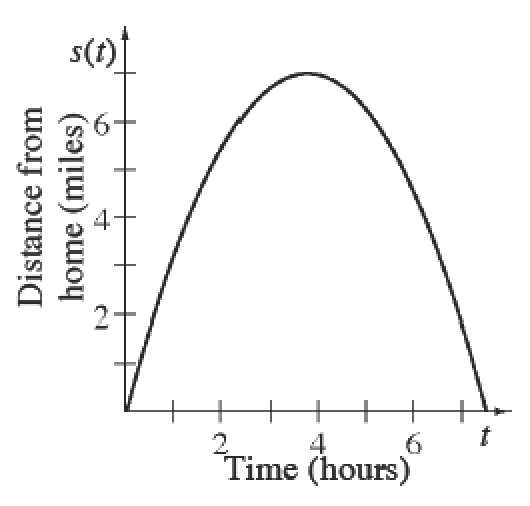
The graph of
involves an employee of a calculator company. Use a complete sentence to . Include units of measure.
.png)
The graph of
involves a babysitter. Use a complete sentence to describe the physical meaning of . Include units of measure.
.png)
The graph at right shows the velocity (in miles per hour) of a car during a road trip. At time
Write a function for
. How far north has the car traveled at
hours? At hours? Explain what happened to the car for
hours. Set up an integral to represent the displacement from
. Set up an integral to represent the total distance from
.
.png)
During this course, you have studied the connection between distance and velocity. Homework Help ✎
What is the relationship among position, velocity, and the Fundamental Theorem of Calculus?
Considering your answer from part (a), write a function to represent the car’s position,
, from problem 4-111.
Without graphing, analytically determine where the function
Differentiate the following functions. Determine if each function is differentiable for all real values of
Write a Riemann sum to approximate
A function has a derivative of
If
, what was the original function? If
, what was the original function? Describe how you found the constant of integration in parts (a) and (b).


